

Gold fell more than 2% on Thursday and remained near $4,050 an ounce in early Asian trading on Friday, 24 July, as surging oil prices intensified inflation concerns. Higher US Treasury yields and a firmer dollar outweighed demand for bullion as protection against the escalating Middle East conflict.
Market Snapshot
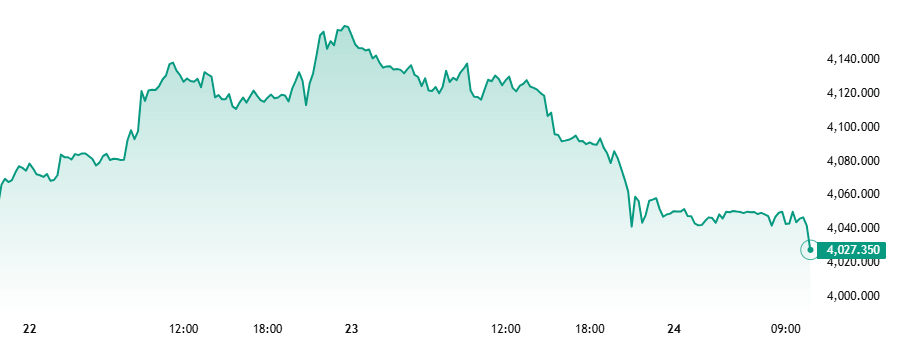
Spot gold (XAU/USD) dropped 2.1% to $4,043.14 an ounce by 1810 GMT on Thursday, retreating sharply from the two-week high reached a day earlier. US gold futures for August delivery settled about 2.5% lower at $4,050.20.
Bullion faced further selling pressure near $4,050 during Friday’s early Asian session. The US dollar gained 0.3% on Thursday, while the benchmark 10-year Treasury yield climbed to its highest level in more than a year, reducing the appeal of non-yielding gold.
Oil Shock Drives Inflation Fears
Brent crude rose more than 6% and moved above $100 a barrel for the first time since May after Yemen’s Iran-aligned Houthi movement said it had attacked two Saudi oil tankers in the Red Sea. The development raised fears that disruption could spread from the Strait of Hormuz to a second major energy-shipping route.
Higher crude prices can increase fuel, freight and production costs across the global economy. That has weakened the effect of softer US consumer and producer inflation reports released earlier in July and strengthened expectations that central banks may have to keep borrowing costs elevated.
Jim Wyckoff, a market analyst at American Gold Exchange, said “rising bond yields are the enemy of gold and silver market bulls”. Gold does not pay interest, making it less attractive when government debt offers higher returns.
Conflict Expands to Red Sea
The Houthis said they struck the Saudi tankers Encelia and Layla after announcing a blockade of Saudi ports. A maritime security source confirmed that the Encelia issued a distress call after being hit near the Saudi port of Jizan, although the reported attack on the Layla was not independently verified.
US President Donald Trump threatened further military action against Iran and the Houthis if attacks on commercial shipping continued. The US military later said it had completed a 13th consecutive night of strikes on Iran, targeting military command centres, drone facilities, surveillance sites and maritime capabilities.
The widening conflict presents a mixed backdrop for gold. Geopolitical instability normally encourages investors to seek defensive assets, but the resulting energy shock is also lifting inflation expectations, bond yields and the dollar.
Fed Expectations Shift
Interest-rate futures indicated an approximately 36% probability that the Federal Reserve would raise rates at its 28 to 29 July meeting, according to CME pricing cited by FXStreet. The probability of at least a quarter-point increase by September rose to about 82% to 83%, up sharply from the previous session.
Investors generally expect no immediate change next week, but attention will focus on Fed Chair Kevin Warsh’s assessment of the oil shock and its potential effect on inflation. Wyckoff said markets anticipated “maybe a hawkish lean on the rhetoric”, while warning that an unexpected policy signal could produce a larger market reaction.
The repricing has reversed part of gold’s earlier recovery. Bullion had climbed to a two-week high on Wednesday as dollar weakness and renewed buying near $4,000 encouraged investors to rebuild positions.
Precious Metals Retreat
The selling extended across the precious-metals market. Spot silver dropped 3.8% to $57.44 an ounce, platinum declined 3.3% to $1,590.58 and palladium fell 2.7% to $1,256.50.
The broad decline suggested that tighter financial conditions were dominating safe-haven demand. It also reflected profit-taking after metals had advanced earlier in the week.
Outlook
Traders will watch whether oil remains above $100, whether attacks disrupt tanker traffic through the Red Sea or Strait of Hormuz, and whether Washington expands its military campaign against Iran.
The Federal Reserve’s July decision will be the next major policy test. A more hawkish message, further gains in Treasury yields or renewed dollar strength could push gold back towards $4,000, while de-escalation or weaker economic data could help bullion stabilise near $4,050.