

Gold rose above $4,100 an ounce in early Asian trading on Thursday, extending a sharp rebound as a weaker US dollar, technical buying and persistent Middle East tensions brought investors back to bullion. Spot gold (XAU/USD) traded near $4,125 after gaining 1.7% on Wednesday and reaching a two-week high.
Market Snapshot
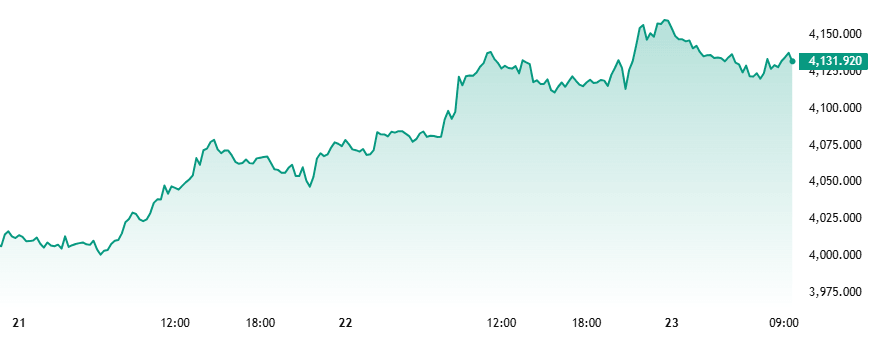
Spot gold rose to $4,145.24 an ounce by 1641 GMT on Wednesday after touching $4,165.87, its highest level since 7 July. US gold futures for August delivery settled 1.9% higher at $4,151.90.
The recovery followed a volatile period in which gold briefly fell below $4,000 as rising oil prices and US Treasury yields increased expectations that interest rates would remain elevated. Thursday’s early advance suggested buyers continued to view the $4,000 area as an important support level.
Other precious metals also advanced on Wednesday. Silver gained 2% to $59.98 an ounce, platinum rose 0.7% to $1,640.63 and palladium added 1.4% to $1,299.47.
Dollar Weakness Supports Bullion
The US Dollar Index softened after four consecutive daily gains, making dollar-denominated gold less expensive for buyers using other currencies. The currency’s pullback combined with short-covering and renewed purchases following gold’s recent decline.
Lukman Otunuga, senior research analyst at FXTM, said a weaker dollar and dip-buying had provided “fresh inspiration” for gold bulls. He cautioned that rising oil prices and tighter monetary conditions could still restrict further gains.
Ryan McKay, senior commodity strategist at TD Securities, described the recovery as “mostly flow-driven”, adding that buyers appeared relieved that gold had held above $4,000. He said renewed energy-price pressure could prevent the rebound from developing into a sustained upward trend.
Middle East Risks Sustain Demand
Safe-haven demand remained supported as the US-Iran conflict entered a 12th consecutive night of American strikes. US Secretary of State Marco Rubio said Washington remained willing to negotiate, but accused Tehran of not seriously pursuing an agreement.
Risks to commercial shipping also expanded beyond the Strait of Hormuz. Yemen’s Iran-aligned Houthi movement claimed attacks on two Saudi oil tankers in the Red Sea, while five tankers changed course to avoid the Bab el-Mandeb Strait. One reported attack was confirmed by a maritime security source, while the second remained unverified.
US President Donald Trump threatened to strike Iranian bridges or power facilities in response to attacks on vessels. Iran warned that any such action would prompt retaliation against regional energy and economic infrastructure.
Oil and Rates Limit Gains
Brent crude settled 3.3% higher near $94 a barrel on Wednesday as tanker diversions raised concerns about simultaneous disruption in the Strait of Hormuz and the Red Sea. The two routes together handle more than a quarter of global oil and gas shipments.
Higher energy costs could feed into transport and consumer prices, complicating the Federal Reserve’s inflation outlook. The US 10-year Treasury yield rose to about 4.66%, while the policy-sensitive two-year yield reached a 17-month high. Rising bond yields generally reduce gold’s appeal because bullion pays no interest.
Markets were assigning about a 76% probability to a Federal Reserve rate increase in September. The central bank is due to hold its next two-day policy meeting on 28 and 29 July, when investors will closely examine its assessment of energy-driven inflation.
Broader Market Impact
Gold is receiving support from geopolitical uncertainty, but the conflict is also creating conditions that can weigh on the metal. Supply disruptions can strengthen haven demand while simultaneously lifting inflation expectations, Treasury yields and the dollar.
This tension has made gold increasingly sensitive to daily changes in crude prices and interest-rate expectations. A sustained move in oil towards $100 could reinforce expectations for tighter monetary policy, while a diplomatic breakthrough could reduce both energy inflation and demand for defensive assets.
Outlook
Traders will watch the dollar and US Treasury yields for signs that Wednesday’s buying can continue. Attention will also focus on the Federal Reserve’s July meeting and any change in expectations for a September rate increase.
Developments in the Strait of Hormuz and Bab el-Mandeb will remain central. Further tanker attacks or shipping diversions could support haven demand, while credible negotiations between Washington and Tehran could reduce gold’s geopolitical risk premium.