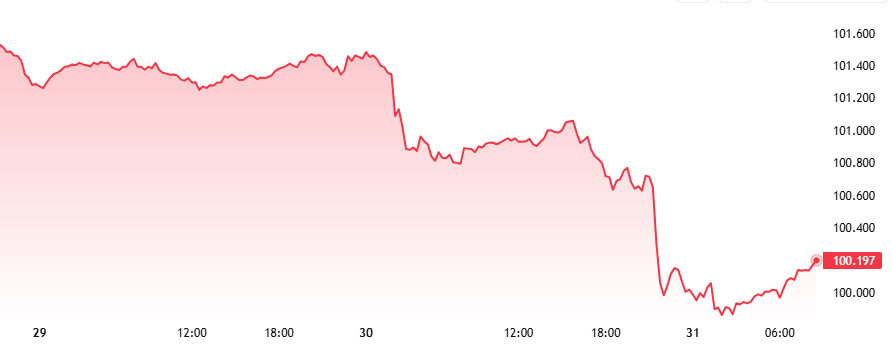


The US dollar held near the 100 mark on Tuesday as traders awaited US consumer price data and monitored tensions between Washington and Tehran. The Dollar Index (DXY) was around 99.75 in Asian trading, little changed on the day, after recovering from recent losses.
Market Snapshot
The index has struggled to extend the previous session’s gains, but the decline has been limited by demand for defensive assets. Investors remain cautious as uncertainty over the Iran crisis adds a geopolitical risk premium to the greenback.
The dollar’s immediate direction is likely to depend on whether the July inflation report changes expectations for Federal Reserve policy. Markets have reduced bets on a September rate increase following a weaker-than-expected US jobs report, with fed funds futures recently pricing the probability of a hike at below 50%.
Event Details
The US Consumer Price Index is due on Wednesday, followed by the Producer Price Index on Thursday. The figures will provide the first major test of whether price pressures are rebuilding after annual inflation fell to 3.5% in June from 4.2% in May.
A stronger-than-expected reading could push Treasury yields higher and encourage investors to rebuild positions for tighter monetary policy. A softer result would reinforce expectations that the Fed can keep rates unchanged or consider easing as labour-market conditions weaken.
The data will also be assessed against the impact of energy prices. Any disruption involving Iran or the Strait of Hormuz could lift oil prices, raise inflation concerns and complicate the Fed’s policy decisions.
Trading Reaction
The dollar’s recovery has been uneven. It briefly moved back towards the 100 level earlier in the month after falling to its weakest point since mid-June, supported by stronger US manufacturing data and renewed concern over US-Iran relations.
However, investors have remained reluctant to make large directional bets before the inflation figures. The DXY is trading close to a psychologically important threshold, leaving the index vulnerable to a sharp move if the data diverge materially from expectations.
Market participants are also weighing two competing forces. Higher oil prices and geopolitical stress could support the dollar through safe-haven demand, while weaker employment data and a less hawkish Fed outlook could limit gains.
Background Context
US President Donald Trump has said negotiations with Iran could resume, but diplomatic signals have remained uncertain. Earlier hopes of a breakthrough faded after Iranian officials denied that talks were under way, while warnings relating to shipping through the Strait of Hormuz kept energy-market risks elevated.
The broader dollar outlook has also been affected by changing expectations for US interest rates. Investors had previously increased bets on a possible Fed hike as energy-related inflation risks intensified. Those expectations weakened after the latest employment report, adding to uncertainty around the timing of the central bank’s next move.
A currency strategist said the CPI report would determine whether recent dollar strength reflected a durable shift in rate expectations or merely temporary protection against geopolitical risk. A trader said the market was likely to react most sharply to the core inflation figures, which exclude food and energy and may offer a clearer signal of underlying price pressure.
Those comments are editorial placeholders and should be replaced with verified, on-the-record sources before publication.
Outlook
Traders will watch the headline and core CPI readings, movements in US Treasury yields and any revisions to expectations for the Fed’s September meeting.
They will also monitor oil prices and developments involving Iran, particularly any threat to shipping routes or signs of renewed negotiations. A sustained break above 100 on the DXY could signal stronger momentum, while a move below recent support would suggest that rate uncertainty remains the dominant pressure on the dollar.