

US stock index futures rose on Friday as Amazon’s strong cloud-computing results renewed confidence in artificial intelligence investment. Gains were restrained by a sharp after-hours decline in Apple after its sales outlook fell short of market expectations.
Market Snapshot
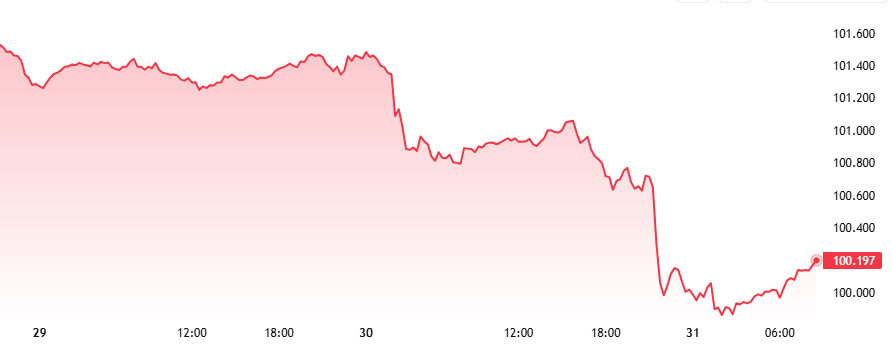
S&P 500 futures gained 0.26% to 7,491.75 points by 0010 GMT. Nasdaq 100 futures advanced 0.7% to 28,440, while Dow Jones futures rose 0.2% to 52,506.
Amazon.com (AMZN.O) climbed about 9% in extended trading after reporting faster growth at Amazon Web Services. Apple (AAPL.O) fell 5.5% after warning that component shortages would restrict its ability to meet demand during the September quarter.
The futures advance followed a strong cash session on Thursday. The S&P 500 rose 1.66%, the Nasdaq Composite gained 2.78% and the Dow Jones Industrial Average added 1.19%, led by Microsoft and semiconductor shares.
Amazon Cloud Growth Accelerates
Revenue at Amazon Web Services rose 37% from a year earlier to $42.2 billion in the quarter ended 30 June. The increase marked AWS’s fastest expansion in 18 quarters and exceeded analysts’ consensus forecast for growth of about 31.2%.
Amazon raised its forecast for 2026 capital expenditure by 10% to $220 billion as it expands data centres, custom chips and other AI infrastructure. The company said computing demand continued to exceed available capacity, with much of its planned AWS capacity for 2027 already reserved by customers.
The spending remains a source of risk. Amazon recorded negative free cash flow of $7.6 billion over the 12 months through June, compared with positive cash flow of $18.2 billion a year earlier. However, AWS contract backlog increased to $496 billion from $364 billion in the previous quarter, strengthening the case that investment could translate into future revenue.
“The AI tide is rising all boats here,” said Dan Morgan, portfolio manager at Synovus Trust. He said Amazon’s results eased concerns that AWS was losing ground to competing cloud providers.
Apple Forecast Overshadows Sales Beat
Apple reported fiscal third-quarter revenue of $109.42 billion, an increase of 16.4% from a year earlier. Earnings reached $2.02 per share, exceeding the $1.89 expected by analysts, even after excluding part of the benefit from US tariff refunds.
iPhone revenue rose 21.7% to $54.25 billion, while Mac sales increased 28.7% to $10.35 billion. Both figures exceeded market forecasts as customers bought devices ahead of possible further price increases caused by shortages of memory and advanced processors.
Investors focused instead on Apple’s September-quarter forecast. The company projected revenue growth of 9% to 11%, below Wall Street’s 12% estimate, and warned that limited flexibility among chip and memory suppliers could prevent it from fulfilling some orders.
Services revenue increased 12.1% to $30.74 billion but missed the $31.22 billion consensus forecast. D.A. Davidson analyst Gil Luria said investors were concerned that slower services growth could become more visible once the current surge in iPhone demand eased.
AI Trade Regains Momentum
The contrasting results reinforced a divide within the technology sector. Investors have rewarded companies showing that cloud and AI revenue can grow quickly enough to justify record infrastructure spending, while penalising businesses whose costs are rising faster than cash generation.
Microsoft (MSFT.O) surged more than 15% on Thursday after issuing an upbeat cloud forecast, its largest daily percentage gain in 18 years. The PHLX semiconductor index jumped 8.2%, while Meta Platforms (META.O) fell about 8% after reporting a steep decline in free cash flow.
Analysts expect aggregate second-quarter earnings among S&P 500 companies to rise about 40% from a year earlier, with AI-related businesses accounting for much of the growth. The index trades near 20 times expected earnings, slightly above its 10-year average, leaving shares sensitive to weaker guidance.
Rates and Geopolitics Remain Risks
Markets were also assessing the Federal Reserve’s decision to leave interest rates at 3.50% to 3.75%. Futures pricing indicated about a 59% probability of a September increase, down from 82% a week earlier, after softer inflation and economic growth data.
Middle East risks remained unresolved. Iran rejected an Omani proposal for regional management of the Strait of Hormuz, although talks continued, while a QatarEnergy-controlled liquefied natural gas tanker completed the first reported passage out of the strait in nearly three weeks.
Outlook
Investors will watch Amazon and Apple’s regular-session share moves to determine whether the technology rally can extend into a second day.
Attention will also turn to the US Employment Cost Index, due at 0830 EDT on Friday, for evidence of wage pressure. Changes in September Fed expectations and further developments around the Strait of Hormuz will provide additional direction for equities.