

U.S. Treasury yields surged to their highest levels since 2007 on Tuesday, with the benchmark 10-year note briefly topping 5.04% as traders positioned for an expected Federal Reserve rate hike on Wednesday. The move marks a significant inflection point for global fixed-income markets, resetting borrowing costs across mortgages, corporate debt, and sovereign issuance.
What happened
The yield on the 10-year U.S. Treasury note climbed as high as 5.04% during the session before settling at around 5.00%, marking its highest closing level in 19 years. The 30-year Treasury yield followed closely at 5.39%, while the 2-year Treasury yield, most sensitive to Federal Reserve policy expectations, rose to 4.68%, its highest level since mid-2024. Interest rate futures indicated a 92% probability of a 25-basis-point rate hike by the Federal Reserve following its two-day Federal Open Market Committee (FOMC) meeting, which concluded on Wednesday.
Why the market reacted
Several converging forces drove the bond selloff:
- Fed rate hike expectations: Traders anticipate the Fed will raise its benchmark rate to 3.75%–4.00% in a bid to combat persistent inflation, marking the first increase since 2023.
- Energy-driven inflation fears: Escalating geopolitical tensions in the Middle East have pushed WTI crude above $104 per barrel, fuelling concerns about a fresh inflation spike.
- Term premium expansion: Investors are demanding higher compensation for holding long-dated debt amid elevated uncertainty, swelling sovereign issuance, and heavy corporate borrowing by AI-focused tech firms.
- Global yield contagion: Bond yields in the UK, Germany, France, and Japan also hit multi-year highs, amplifying pressure on U.S. Treasuries.
Market impact across asset classes
Crossing the 5% threshold on the 10-year note has triggered broad-based repricing across global capital markets:
| Asset Class | Market Reaction | Key Levels / Notes |
|---|---|---|
| Equities | U.S. stock futures and major indices declined; S&P 500 fell 0.4%–0.6%, Nasdaq 100 dropped 0.6%–0.8%, Dow Jones lost 1%. | Higher discount rates compress equity valuations; tech and growth stocks underperform. |
| FX | Dollar index rose for a fifth straight session; USD/JPY reclaimed 155.00. | Stronger dollar pressures emerging-market currencies and commodities priced in USD. |
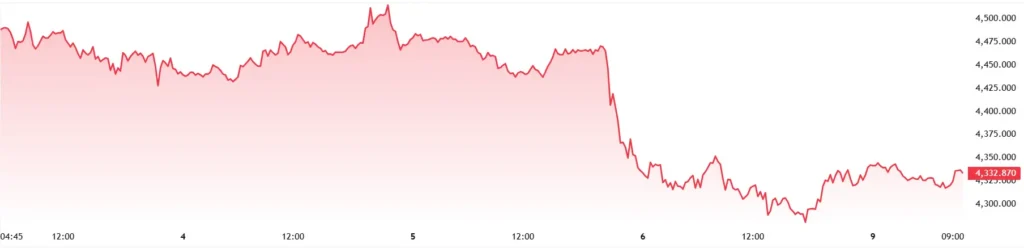
| Commodities | WTI crude surged 3%–4% to $104.39; gold slipped 0.5% to $4,278.85/oz. | Oil prices at highest close since May; gold pressured by higher real yields. |
| Bonds | U.S. 10-year yield at 5.00%–5.04%; 30-year at 5.36%–5.40%; 2-year at 4.65%–4.68%. | Global sovereign yields at multi-year highs; UK 10-year at 5.41%, Germany at 3.54%. |
What this means for Treasuries and financial products
A 5% 10-year yield acts as a macro trigger with wide-ranging implications:
- Mortgage rates: U.S. 30-year fixed mortgage rates are poised to climb toward multi-decade peaks, dampening housing demand.
- Corporate borrowing: Higher risk-free rates increase debt-servicing costs for leveraged firms and compress the equity risk premium, making bonds more attractive relative to stocks.
- Federal budget: Elevated yields raise interest expenses on the national debt, intensifying fiscal pressure amid large deficits.
- Fixed-income opportunity: Some analysts view the selloff as a potential entry point for long-term bond investors, citing improved risk-reward after years of near-zero rates.
What traders should monitor
- FOMC decision and guidance: Wednesday’s rate decision and Chair Warsh’s press conference will set the tone for near-term yield direction.
- 2-year vs. 10-year spread: Watch for further inversion or steepening, which signals shifting expectations for growth and policy.
- 30-year yield trajectory: Sustained moves above 5.4% could signal deeper term premium expansion and long-term inflation concerns.
- Oil prices and geopolitics: Further escalation in the Middle East could drive additional inflation and yield pressure.
- Equity market response: Continued weakness in rate-sensitive sectors (tech, real estate, utilities) may accelerate if yields hold above 5%.
- Dollar strength: A firmer USD could weigh on emerging markets and commodity prices, feeding back into global growth concerns.
Treasury Secretary Scott Bessent is scheduled to testify before Congress this week, adding another layer of scrutiny to bond market dynamics as policymakers grapple with the dual challenges of inflation control and fiscal sustainability.