

US consumer prices rose only modestly in July, reinforcing expectations that the Federal Reserve could keep interest rates unchanged in September as inflation eased and the labour market weakened. The Consumer Price Index increased 0.1% from June and 3.4% from a year earlier, both in line with economists’ forecasts.
Inflation Snapshot
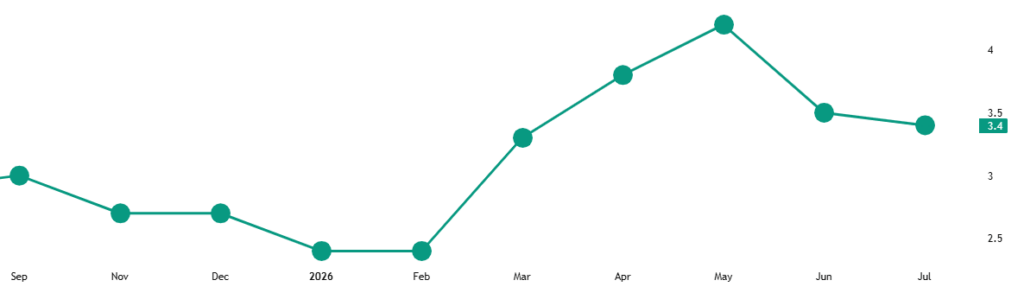
The 0.1% monthly increase followed a 0.4% decline in June, the first fall in consumer prices in six years. Annual inflation slowed from 3.5% to 3.4%, although it remained well above the Fed’s 2% objective.
Core CPI, which excludes volatile food and energy prices, rose 0.2% after being unchanged in June. The annual core rate eased to 2.5% from 2.6%, extending signs that underlying price pressures were gradually moderating.
Scott Anderson, chief US economist at BMO Capital Markets, said the figures “should further ease the Fed’s fears about an energy-driven inflation spiral”, while cautioning that officials would need more evidence that services inflation was cooling.
Petrol and Shelter Drive Moves
Gasoline prices fell 2.9% in July after dropping 9.7% in June, limiting the headline increase despite earlier disruption to global energy markets from the Middle East conflict. Food prices edged 0.1% higher, while grocery prices declined 0.1%.
Shelter costs rose 0.1% and accounted for about two-thirds of the overall monthly CPI increase. Hotel and motel prices dropped 3.3%, partly offsetting higher rents. Healthcare costs increased 0.4% and airfares climbed 2.2%.
Some goods categories showed renewed pressure. Information technology products rose 1.4%, including a 3.5% increase in computers, peripherals and smart-home devices. Core goods prices increased 0.2% following two consecutive monthly declines, suggesting some businesses were still passing higher distribution and tariff-related costs to consumers.
Markets Trim Fed Hike Bets
US financial markets reacted positively to the report. Shortly after the release, the Nasdaq Composite (.IXIC) gained about 0.9% and the S&P 500 (.SPX) rose 0.5%. The dollar index slipped 0.1% to 99.66.
The policy-sensitive two-year Treasury yield fell 4.2 basis points to 4.176%, while the benchmark 10-year yield declined 3.2 basis points to 4.652%. Later pricing showed traders assigning roughly a 38% probability to a September Fed rate increase, down from 48.4% a day earlier.
Robert Pavlik, senior portfolio manager at Dakota Wealth, said the figures coming in as expected reduced concern that inflation would force the Fed towards an immediate increase.
Weak Jobs Data Complicate Decision
The inflation report followed unexpectedly weak July employment data. US nonfarm payrolls fell by 23,000, compared with economists’ expectations for an 80,000 increase, while May and June payroll estimates were revised down by a combined 103,000.
The unemployment rate edged down to 4.1%, but the decline partly reflected 264,000 people leaving the labour force. Participation fell to 61.4%, its lowest level in nearly five and a half years.
That combination of softer hiring and easing inflation strengthens the argument for patience. The Fed voted 9 to 3 on 29 July to keep its benchmark rate at 3.50% to 3.75%, although three policymakers favoured an immediate increase.
Inflation Risks Have Not Disappeared
Consumers continue to face pressure from the cumulative rise in prices. Inflation-adjusted average hourly earnings were 0.2% lower in July than a year earlier and have been flat or declining since April.
Energy remains another risk. Oil prices have risen again in August as the US-Iran conflict and restrictions around the Strait of Hormuz continue to disrupt global supplies. Economists expect some of that increase to appear in August inflation figures.
Outlook
Traders will next watch Thursday’s Producer Price Index and the August employment and CPI reports before the Fed meets on 15 and 16 September.
The direction of oil prices will also remain important. Further moderation in core inflation combined with weak hiring could strengthen the case for another Fed hold, while renewed energy inflation or broader increases in goods and services prices could revive expectations for a rate increase later this year.