

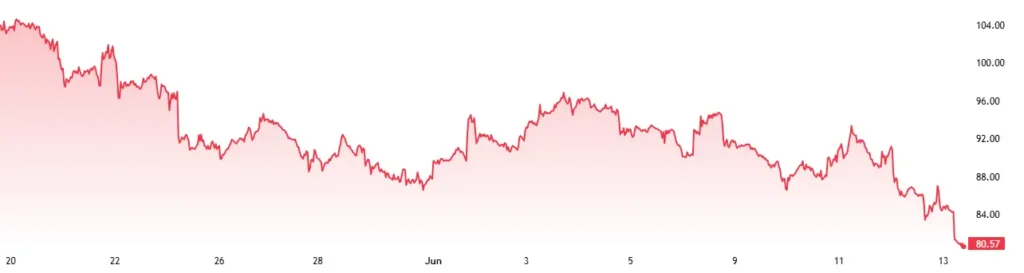
Oil prices tumbled more than 4% on Monday after US President Donald Trump and Iran’s deputy foreign minister announced an initial peace deal to end hostilities and restore shipping through the Strait of Hormuz, easing global supply fears. Brent crude (LCOc1) fell $3.51, or 4.02%, to $83.82 by 2203 GMT, while US West Texas Intermediate (CLc1) dropped $3.93, or 4.63%, to $80.95 a barrel.
Market snapshot
Brent crude booked its biggest single-day decline since March, slipping to its lowest level in over three months. WTI crude also fell sharply, erasing recent gains built on war-risk premiums. Asian stocks rallied on the dovish energy shock, with the Stoxx 600 (SX5E) up 0.9% and S&P 500 (SPX) futures gaining 0.7%.
Event details
The deal, announced Sunday night, includes provisions to reopen the Strait of Hormuz, a critical chokepoint for roughly 20% of global oil exports. Trump confirmed the agreement without detailing specific terms, while Iran’s deputy foreign minister hailed it as a “breakthrough toward lasting peace.” Both sides plan an official signing ceremony on June 18. The Strait had been partially closed since mid-March amid US-Iran clashes, sparking supply disruption alarms.
Risk-off reversal
Equity markets surged as investors unwound geopolitical hedges, with the VIX volatility index dropping 6.2% to 16.8. Safe-haven assets sold off: gold (XAU=) fell 1.8% to $5,240/oz, while the Japanese yen (JPY=) weakened 0.7% to 149.50 per dollar. US 10-year Treasury yields rose 4 bps to 4.26%, reflecting reduced deflationary pressure from cheaper oil.
FX and yields impact
The dollar index (DXY) weakened 0.4% to 107.60 as oil’s decline reduced inflation worries and US yield appeal. Energy-heavy currencies like the Norwegian krone (NOK=) dropped 1.1%, while the Canadian dollar (CAD=) fell 0.6% to 1.3650 per dollar. Emerging-market FX tied to oil imports, including the Malaysian ringgit (MYR=), strengthened 0.5% to 4.12 per dollar.
Macro implications
The peace deal could add 1-2 million bpd to global supply within weeks, potentially lowering global CPI by 0.3-0.5% over 12 months. Goldman Sachs estimates a $5/barrel Brent drop reduces US inflation by 15 bps annually, boosting Fed rate cut odds for September to 72% on CME FedWatch, from 64% pre-deal. Growth outlooks improve as energy costs ease for consumers and industries.
Analyst take
“This is a classic geopolitical risk unwind,” said ANZ strategist Carol Nelson. “Oil’s drop removes a major stagflation scare and gives central banks more room to cut rates.” Hedge funds are likely to trim long-oil positions, with CFTC data Friday expected to show fresh exits.
Key monitors
Traders will watch the June 18 signing ceremony for deal specifics, Iran’s confirmation of full Strait reopening, and Wednesday’s EIA crude inventories for supply flow data. OPEC+ meeting optics next week and Fed commentary on inflation pass-through will shape the next leg.