

US stocks closed higher on Wednesday after a softer producer inflation report reduced expectations for an imminent Federal Reserve rate increase. Strong financial-sector earnings also supported the market, although renewed US strikes on Iran and rising oil prices limited gains.
Market Snapshot
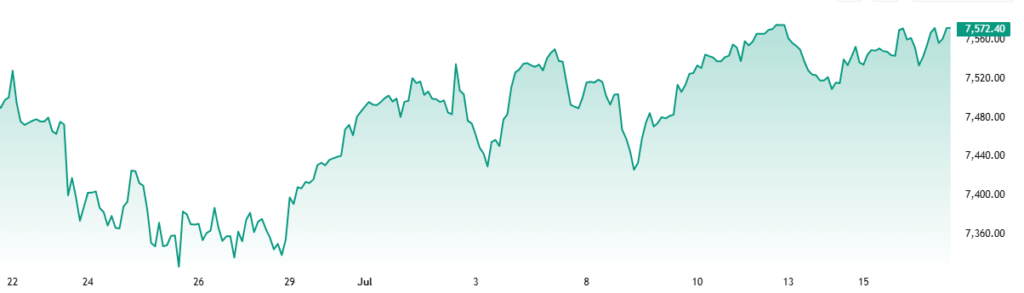
The S&P 500 gained 0.4% to finish at 7,571.01, placing the benchmark about 0.5% below its latest record close. The Nasdaq Composite advanced 0.6% to 26,269.23, while the Dow Jones Industrial Average rose 0.3% to 52,658.52.
Trading was uneven as investors balanced encouraging economic and corporate data against weakness among semiconductor shares. The Cboe Volatility Index fell about 5%, suggesting that immediate demand for protection against a sharp market decline eased during the session.
Producer Inflation Cools
The US Producer Price Index fell 0.3% in June after increasing 0.6% in May, the Bureau of Labor Statistics said. Economists had expected the headline index to remain unchanged. It was the first monthly decline in producer prices since August 2025.
Core producer prices, which exclude food and energy, increased 0.2%, below forecasts for a 0.3% rise. Headline producer inflation stood at 5.5% from a year earlier, while the core measure was 4.7%. A 6.4% decline in final-demand energy prices accounted for much of the monthly improvement.
The figures followed softer consumer inflation data released on Tuesday. Together, the reports led traders to reduce the probability of a quarter-point Fed rate increase at the central bank’s late-July meeting to about 10%.
Bill Adams, chief US economist at Fifth Third Commercial Bank, said “June’s cool inflation” supported keeping rates steady this month. He cautioned that July’s rebound in energy prices could prevent policymakers from declaring that inflation pressures had passed.
Earnings Support Financial Shares
A strong start to the second-quarter reporting season helped offset concerns about elevated equity valuations. BlackRock (BLK) gained 6.6% after its results exceeded market expectations, while Bank of New York Mellon (BK) climbed about 5.1%.
Morgan Stanley (MS) reported quarterly net revenue of $21.3 billion, up from $16.8 billion a year earlier. Net income rose to $5.6 billion, or $3.46 per diluted share, from $3.5 billion, or $2.13 per share, in the same period of 2025.
Charlie Anderson, senior vice-president at UBS Wealth Management, said “strong earnings can continue to propel stocks higher”. However, he said companies increasingly needed to exceed forecasts and raise their guidance as valuations moved higher.
Technology Shares Diverge
Most members of the group of large technology companies known as the Magnificent Seven advanced, helping the Nasdaq outperform. Semiconductor shares were less consistent as investors assessed whether heavy spending on artificial intelligence infrastructure could continue producing earnings growth.
Dutch chip-equipment maker ASML initially gained after reporting stronger results and raising its sales forecast. Its European-listed shares later surrendered an advance of almost 8%, reflecting concerns that strong corporate results were already priced into parts of the technology sector.
Iran Conflict Limits Risk Appetite
Geopolitical risks remained elevated after the US military launched another wave of strikes against Iranian coastal defence and missile sites at around 1000 GMT. Washington said the operation targeted capabilities used to threaten commercial shipping around the Strait of Hormuz.
Brent crude rose above $85 a barrel and had gained nearly 13% during the week. Some commercial vessels were also avoiding US military-guided passages through Hormuz after attacks near the strategic waterway, which carries a significant share of global energy exports.
Higher energy prices could reverse part of June’s inflation improvement, raise corporate transport costs and reduce the Fed’s flexibility to lower or hold interest rates.
Outlook
Investors will next watch further corporate earnings, particularly from technology and consumer companies, for evidence that profit growth can support the market near record levels.
Traders will also monitor Fed officials’ response to the latest inflation data and changes in interest-rate expectations. Oil prices, shipping traffic through the Strait of Hormuz and any further US-Iran military escalation will remain key risks for equities and the inflation outlook.