

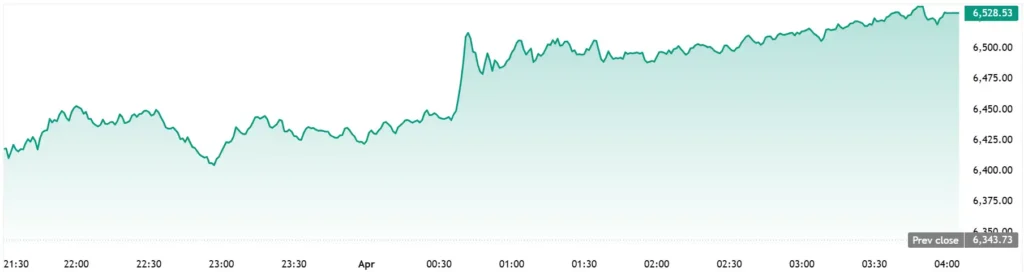
US equity index futures jumped 1% in evening trade on Monday, reversing session losses, after a report said President Donald Trump is considering ending the Iran conflict even if the Strait of Hormuz remains closed, easing fears of a prolonged supply shock.
Market snapshot
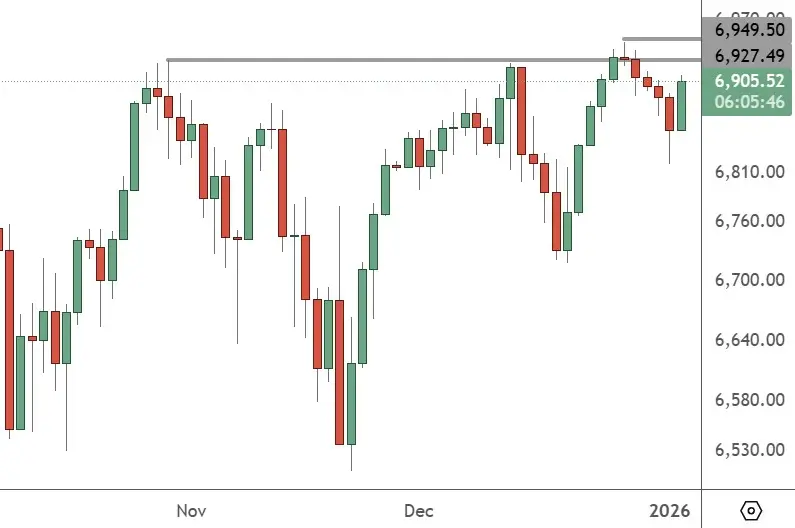
S&P 500 futures (ESc1) rose 0.9% to 6,446.75, Nasdaq 100 futures (NQc1) gained 1% to 23,364.0, and Dow Jones futures (YM c1) advanced 1% to 45,902.0 by 21:43 ET. The rally came after cash indexes closed mixed, with the S&P 500 (SPX) down 0.4% at 6,343.72 and the Nasdaq Composite (IXIC) falling 0.7% to 20,794.64, while the Dow Jones Industrial Average (DJI) edged up 0.1% to 45,216.14.
Brent crude (LCOc1) trimmed gains to around $78.50 a barrel after touching $82 earlier, while WTI (CLc1) fell 1.5% to $74.20 on deescalation hopes. Gold (GCc1) eased 0.8% to $4,475 an ounce from a March 30 close of $4,511, and the Dollar Index (DXY) slipped 0.2% to 99.69 as risk appetite improved. The 10-year Treasury yield (US10Y) dipped 3 basis points to 4.32%.
Event details
Trump told aides he is willing to wind down hostilities once US forces cripple Iran’s navy and missile stocks, even if Tehran does not immediately reopen Hormuz, the Wall Street Journal reported, citing administration officials. The president and his team assessed that a military mission to force the strait open would likely extend the conflict beyond his initial four-to-six week timeline, prompting a shift toward achieving core objectives and then pressing Tehran diplomatically.
Washington is expected to urge European and Gulf allies to take the lead on reopening the waterway, which handles about 20% of global oil consumption, while the US focuses on ending direct combat operations. Iran has repeatedly called for a cessation of hostilities before any direct negotiations, raising the prospect that a US pullback could spur broader deescalation.
Risk-off flows ease
“The market is pricing in a higher probability that the Hormuz disruption will be time-limited rather than a structural supply shock,” said a London-based macro strategist at a major bank. “That allows equities to recover while oil gives back some of its war premium.”
Technology shares, which weighed on indexes during the session amid concerns over artificial intelligence valuations and softer-than-expected chip demand, found support in the futures session as geopolitical risk receded. Energy and defense stocks, which had led gains during the escalation phase, gave back some ground as traders rotated into rate-sensitive growth names.