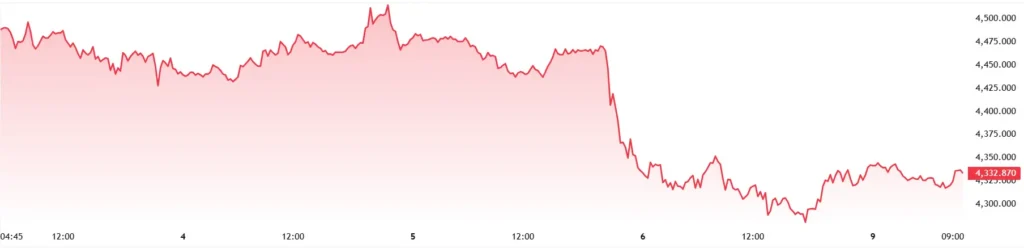


Gold fell below $4,000 an ounce on Thursday and extended its decline to around $3,975 in early Asian trading on Friday, as escalating Middle East tensions lifted energy prices, Treasury yields and expectations for another US interest-rate increase. The decline outweighed traditional safe-haven demand for the precious metal.
Market Snapshot
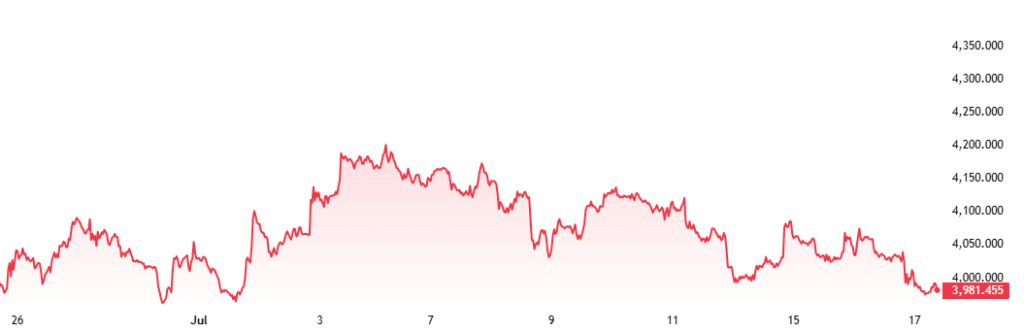
Spot gold (XAU/USD) dropped 1.9% to $3,984.64 an ounce in late New York trading on Thursday after falling as much as 2% during the session. US gold futures settled 1.5% lower at $3,992.10 an ounce.
The metal weakened further during Friday’s early Asian session, reaching about $3,975. The US dollar gained 0.2% on Thursday, while the benchmark 10-year Treasury yield moved higher, increasing the opportunity cost of holding non-yielding bullion.
Energy Threat Broadens
Market concerns intensified after three sources told Reuters that Iran had asked Yemen’s Houthi movement to prepare to disrupt shipping through the Bab el-Mandeb strait if the United States attacked Iranian power infrastructure. Iran and the Houthis had not publicly confirmed the reported instruction.
The threat followed renewed US strikes on Iranian coastal defences and missile sites. A fragile truce reached in June has collapsed, disrupting energy shipments through the Strait of Hormuz, which handled about one-fifth of global oil and liquefied natural gas trade before the conflict.
Bab el-Mandeb connects the Red Sea with the Gulf of Aden. About 7.4 million barrels of petroleum passed through the route each day in June, representing roughly 7% of global oil production, according to Kpler data.
Alex Hodes, energy market strategy director at StoneX, said the development created a “serious risk” that the region’s two main oil export routes could face disruption at the same time.
Rate Expectations Rise
Although Brent crude settled 0.9% lower at $84.23 a barrel on Thursday, it remained near a one-month high after advancing sharply earlier in the week. US West Texas Intermediate crude closed at $78.95 a barrel.
Higher energy and transport costs could feed back into consumer prices, complicating the Federal Reserve’s efforts to control inflation. Interest-rate futures showed traders assigning about a 53% probability to a Fed increase in September, despite softer US inflation figures released earlier in the week.
Bart Melek, global head of commodity strategy at TD Securities, said rising Brent prices were keeping alive the prospect of “a rate hike as early as September”. Higher expected interest rates tend to weigh on gold because the metal offers no yield.
Softer Data Loses Influence
US consumer prices fell 0.4% in June, their largest monthly decline since April 2020, while annual inflation slowed to 3.5% from 4.2% in May. Core inflation eased to 2.6% from a year earlier.
Producer prices also declined 0.3% in June, led by a 6.4% fall in energy costs. However, those figures largely reflected conditions before the latest rise in oil and shipping-related expenses, limiting their influence on expectations for future inflation.
The changing energy outlook helped strengthen the dollar and Treasury yields, drawing some investors away from bullion. Gold can benefit from geopolitical instability, but that support can be overwhelmed when the same crisis raises inflation and interest-rate expectations.
Precious Metals Retreat
Losses spread across the wider precious-metals market. Spot silver fell 3.6% to $55.68 an ounce, platinum declined 3.1% to $1,621.83 and palladium dropped 4.1% to $1,260.70.
The broad decline suggested that investors were responding to tighter financial conditions rather than seeking protection across the metals complex. Industrial metals also faced uncertainty over whether higher energy and freight costs would weaken global demand.
Outlook
Traders will watch whether tensions spread to Bab el-Mandeb, whether tanker traffic through Hormuz deteriorates further and how oil prices respond to any additional US or Iranian military action.
Markets will also assess upcoming comments from Federal Reserve officials and fresh US economic data for evidence that policymakers are moving closer to another rate increase. A further rise in the dollar or Treasury yields could keep gold under pressure, while diplomatic progress or weaker economic figures could help stabilise prices below $4,000.