

S&P 500 futures edged higher on Monday, 17 August, as softer US economic data reduced expectations for another Federal Reserve rate increase. Strong corporate earnings continued to support the broader equity market, although elevated oil prices and uncertainty around the US-Iran conflict limited gains.
Market Snapshot
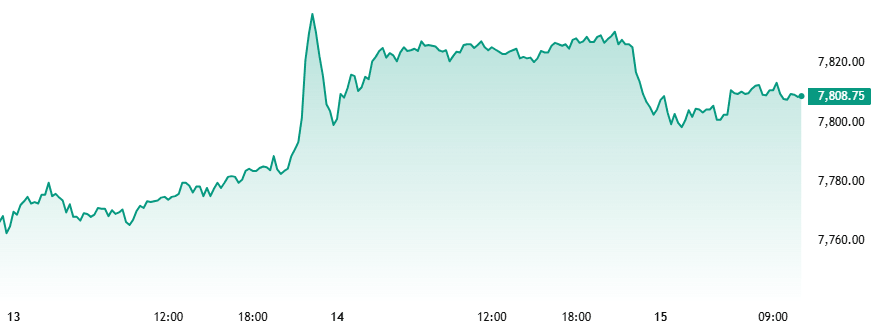
S&P 500 futures rose about 0.1% to 7,809.50 points by 0053 GMT, keeping the benchmark close to recent record territory after three consecutive weeks of gains.
Nasdaq 100 futures gained around 0.2%, while Dow Jones futures slipped 0.1%, leaving the S&P 500 broadly representative of a cautious but still positive tone across US equity markets.
The S&P 500 had closed Friday at 7,785.76, down 0.17% for the session. The modest decline followed a series of record highs as investors balanced strong corporate earnings against questions over inflation, interest rates and slowing consumer activity.
Softer Data Reduce Rate Pressure
Expectations for tighter Federal Reserve policy weakened after US retail sales unexpectedly fell 0.6% in July, their first decline in nine months and the sharpest fall in more than a year. Economists had expected a slight increase.
Core retail sales, which are more closely linked to consumer spending calculations, declined 0.4%. Consumer sentiment also deteriorated, with the University of Michigan’s preliminary August index falling to 51.0 from 55.2 in July.
The reports followed relatively subdued inflation figures. Consumer prices rose only 0.1% in July, while producer prices were unchanged.
The combination encouraged investors to reduce expectations for an interest-rate increase at the Fed’s September meeting. Lower rate expectations tend to support the S&P 500 by reducing financing costs and increasing the relative appeal of equities compared with bonds.
US Treasury yields also eased early on Monday, with the policy-sensitive two-year yield falling towards 4.16%.
Earnings Provide Support
Corporate profits remain an important source of support for the S&P 500. Roughly 85% of index companies that had reported second-quarter results beat analysts’ earnings expectations, according to LSEG data cited in recent market reports.
Profit growth has been particularly strong among large technology and artificial-intelligence-related companies. Amazon (AMZN), Microsoft (MSFT) and other technology groups have reported strong demand for cloud computing and AI infrastructure, helping justify some of the sector’s elevated valuations.
The strength of these large companies matters disproportionately for the S&P 500 because the index is weighted by market capitalisation. Gains in technology megacaps can therefore offset weakness across smaller sectors and companies.
Investors will now examine results from major US retailers including Home Depot (HD), Target (TGT), TJX Companies (TJX) and Walmart (WMT) for evidence of whether weaker July consumer spending is beginning to affect corporate revenues.
Valuations Remain in Focus
The S&P 500’s prolonged advance has pushed valuations above historical averages, increasing the importance of earnings growth.
Strong results can support current prices, but companies that miss forecasts or issue cautious guidance may face sharper reactions as investors question whether profits can continue growing fast enough to justify premium multiples.
The market is also increasingly dependent on a relatively small group of large companies. That concentration has supported index-level gains but leaves the benchmark sensitive to disappointing results from major technology stocks.
Oil and Iran Conflict Remain Risks
The Middle East remains one of the largest external risks to the S&P 500 outlook.
Brent crude remained close to $90 a barrel on Monday as negotiations between Washington and Tehran showed limited progress and shipping through the Strait of Hormuz remained restricted.
A sustained rise in crude could increase fuel, transport and manufacturing costs for US companies. It could also push consumer inflation higher and revive expectations that the Fed may need to raise rates.
The effect would vary across the index. Energy producers could benefit from higher crude prices, while airlines, manufacturers, retailers and other fuel-sensitive sectors could face increased costs.
Outlook
S&P 500 traders will watch this week’s retail earnings for evidence that weaker consumer spending is affecting corporate profits. Wednesday’s minutes from the Federal Reserve’s July meeting will also be scrutinised for clues about whether policymakers still see another rate increase as necessary.
Attention will then shift to US business activity data and the Federal Reserve’s Jackson Hole symposium later in August. Oil prices and developments around the Strait of Hormuz remain another key variable, with renewed energy inflation capable of challenging both the Fed outlook and the S&P 500’s recent rally.