

Natural gas prices have surged to three-year highs amid Russian sanctions and robust export demand.
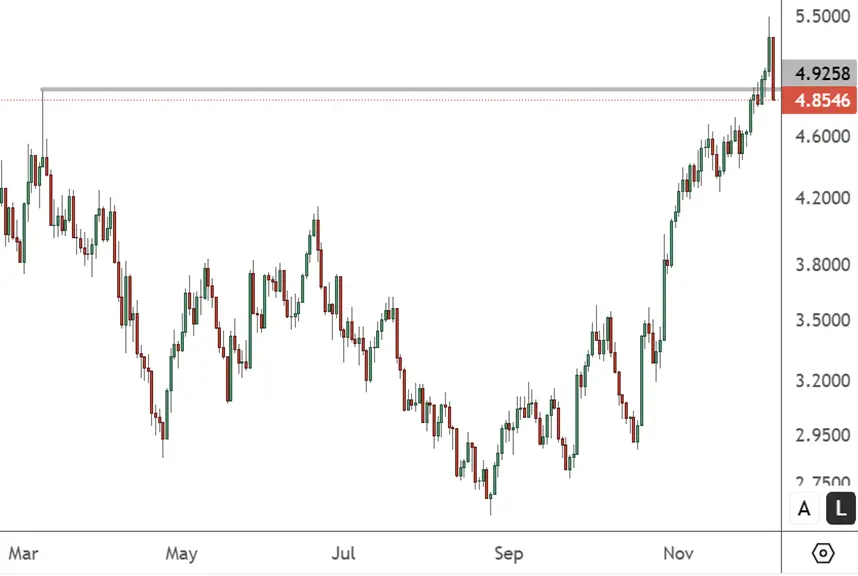
NGAS – Daily Chart
The price of NGAS surged above the March high at $.9258. That has now dipped to $4.8546, suggesting a potential double top. Buying support here could continue the current bullish posture.
Unlike previous speculative winter rallies in recent years, the current advance is being driven by structural supply tightness and record export activity that has altered the market balance more quickly than expected.
The fundamentals behind the breakout are clear, with U.S. LNG exports surging to 10.9 million metric tonnes in November. That marked a second straight monthly record as liquefaction demand crossed 18 billion cubic feet per day.
Europe remained the dominant destination for U.S. LNG exports, accounting for 70% of U.S. LNG shipments. The region’s reliance on Atlantic Basin supply showed that there were limited alternatives as Russian gas remains structurally sidelined. Turkey has risen to become a buyer, with 12 cargoes, a jump from one the previous month.
Asia reduced its purchases as spot price signals were softer and the Japan–Korea benchmark provided little incentive for arbitrage opportunities. The current demand patterns have tightened U.S. balances while domestic production has been steady.
Natural gas is now in a tight spot ahead of potentially cooler winter weather and increased demand due to Russia. Elevated LNG demand and supportive temperatures suggest the market has some room to withstand higher prices. But any abrupt change in the weather could add to the pressure on importing nations.
Europe could be particularly at risk if the winter weather is colder than expected, with continued sanctions on Russia’s exports. Forecaster Atmospheric said on Friday that significantly colder-than-normal temperatures are due over the eastern half of the U.S. for December 10-14, and into the following week.
If the cold-weather outlook changes, prices could drop back to recent highs.