

Gold Movement Overview
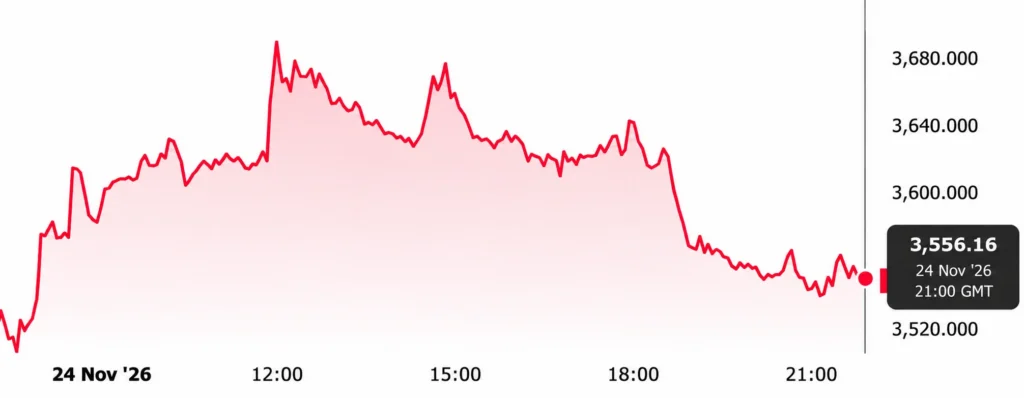
Spot gold fell 2.2% to settle at $3,556.16 an ounce as of the 24 November 2026 US session. Traders locked in gains from the previous session’s sharp rebound, and the AI trade faltered again. Attention also turned to key US inflation data that could shape the Federal Reserve’s future interest rate actions.
Key Driver Behind The Move
Gold came under pressure as the AI trade lost momentum one session after Nvidia reinstated Jensen Huang as chief executive. The return of Huang removed some uncertainty around the chipmaker. Nvidia still faces investigations tied to whether it had any role in sending restricted AI chips to China.
Wider concerns also continued to weigh on the AI trade. Traders remained worried about the heavily debt-funded buildout of AI infrastructure and the uncertain returns on that spending. They also pointed to the regulatory implications for the AI industry and data centres of a sweeping Democratic victory in the US midterm elections.
The pattern is a repeat of last week. Gold slumped then as market participants sold the metal to meet margin calls and cover losses during a rout in the AI trade on Wall Street.
Market Data And Reaction
The Conference Board’s monthly consumer confidence index rose to 103.3 in November, the highest level since January 2025. The Conference Board said the rise was potentially due to lower uncertainty following the midterm elections.
Broader Market Implications
Fed expectations remained the main focus away from the AI trade. Higher rate environments tend to weigh on non-yielding assets such as gold. They also tend to strengthen the dollar, which can make bullion more expensive for foreign buyers.
New York Fed President John Williams said on 23 November 2026 that persistently high inflation points toward tighter policy, with the pace of any further increases depending on incoming data.
Chinese demand has been a source of support for bullion. Gold imports into China have reached a record $209 billion so far this year.
What Gold Traders Should Watch
- The US personal consumption expenditures (PCE) price index for October, due on 25 November 2026. The Fed widely uses it as its preferred inflation gauge, and the index has not been below the central bank’s long-term target since February 2021.
- Further comments from Fed officials on the pace of policy tightening, an ongoing development.
- The investigations into Nvidia over restricted AI chips and China, an ongoing development.
- Concerns over AI infrastructure financing and returns, which remain unresolved.