

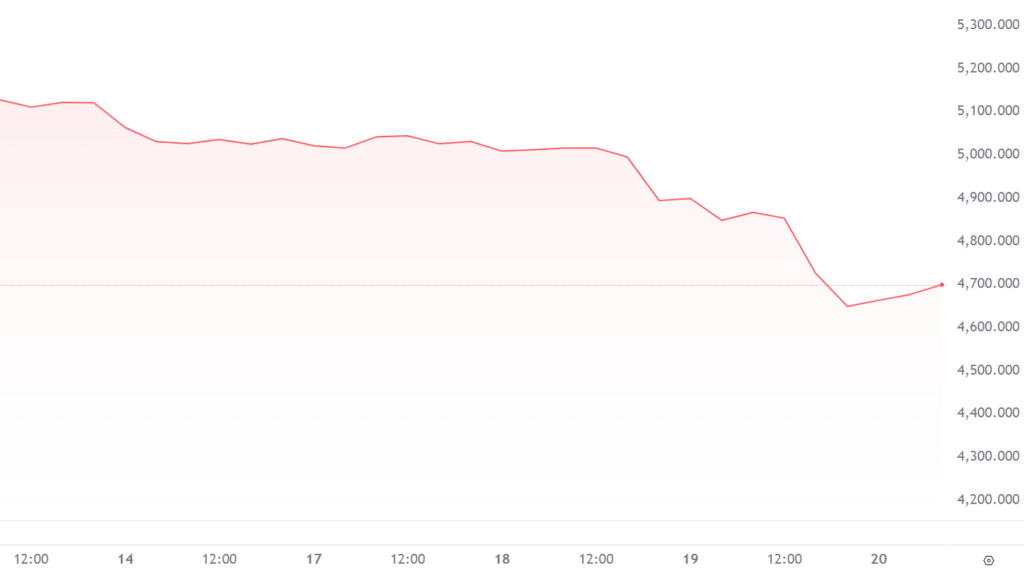
Gold fell below $4,650 in early Asian trade on Friday after a jump in oil prices, persistent inflation fears and cash-raising across broader markets pressured bullion, even as rising Middle East tensions kept a floor under safe-haven demand.
Market snapshot
Spot gold was trading near $4,640, extending losses as investors cut exposure to liquid assets while the U.S. dollar strengthened and Treasury yields stayed elevated, a combination that typically weighs on non-yielding bullion. The move left gold under pressure despite its traditional haven status, underscoring how funding stress and shifting rate expectations can dominate in volatile sessions.
U.S. crude‘s sharp rise has become a central driver of the move, with oil prices up more than 20% in recent weeks, amplifying concerns that energy-led inflation will keep global interest rates higher for longer. That inflation impulse has fed directly into cross-asset positioning, pushing investors out of duration-sensitive assets and into the dollar while weighing on precious metals.
Event details
The main trigger was a renewed repricing of the U.S. interest-rate outlook after the Federal Reserve held rates steady this week and flagged concern about the inflationary impact of higher oil prices. Fed Chair Jerome Powell said the possibility of a rate hike had come up in policy discussions, a hawkish signal that helped lift the dollar and pressure gold.
A stronger dollar, rising US Treasury yields, and diminished expectations of short-term monetary easing are driving gold prices down. The benchmark 10-year US Treasury yield rose to a one-month high, and the dollar also hit its highest level in over three months. From a market perspective, the recent drop in XAU/USD gold prices below $4,650 appears to be a continuation of these macroeconomic trends rather than an independent fluctuation.
Risk-off flows
The decline in bullion also reflects forced selling as investors raise cash to meet margin calls during a broader bout of volatility. “Global markets have seen broad selloffs as investors search for the quickest assets to sell,” Kingswood Group’s Paul Surguy said, adding that investors may now be selling perceived safe-haven assets to fund purchases of markets that had overreacted.
That dynamic helps explain why gold fell alongside other risk assets instead of rallying immediately on geopolitical stress. In a typical risk-off pattern, equities would be expected to weaken, the dollar index would firm, Treasury yields at the front end could stay supported by hawkish Fed pricing, and haven currencies such as the yen and Swiss franc could draw interest even as bullion struggles under liquidation pressure.
Geopolitics and policy
The broader context remains highly sensitive to the situation in the Middle East, with the conflict between the United States, Israel, and Iran causing a sharp rise in oil prices and exacerbating concerns about supply disruptions. Iranian Foreign Minister Abbas Araghchi stated that Iran would “not hold back” if the country’s energy infrastructure were attacked again. Meanwhile, Saudi Arabian Foreign Minister Faisal bin Farhan Al Saud warned that Saudi Arabia’s restraint is not unlimited.
For central banks, the key issue is whether the oil shock becomes embedded in inflation expectations. If energy stays elevated, traders may further scale back expectations for Fed cuts and begin to price a more prolonged restrictive stance, a shift that would pressure gold, weigh on growth-sensitive equities and keep real yields relatively firm.
Outlook risks
For now, traders are weighing two opposing forces: inflation and higher yields are bearish for gold, while geopolitical escalation remains supportive for safe-haven demand. “The focus continues to be clearly on interest rates and Fed rate-hike expectations,” High Ridge Futures’ David Meger said in a previous Reuters report on a similar rates-driven gold selloff, a framing that still fits the current move.
Markets will watch three things next: whether oil extends its rally and deepens inflation fears, whether U.S. yields and the dollar continue to rise, and whether fresh escalation in the Middle East triggers a broader flight to safety across gold, Treasuries and haven currencies. They will also monitor whether the Fed’s hawkish language hardens into a clearer policy shift, which could determine whether gold stabilizes or extends losses toward the next technical support zone below $4,600.