

The Australian dollar fell back to $0.7000 on Monday after stronger-than-expected US manufacturing data revived demand for the greenback. AUD/USD retreated about 0.7% from an intraday high near $0.7050, reversing an earlier advance supported by improved risk sentiment.
Market Snapshot
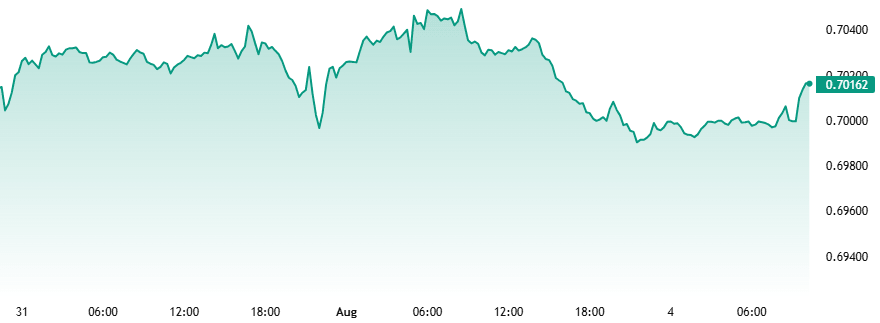
The Australian dollar traded around $0.7000 late in the US session after reaching $0.7050 earlier in the day. The currency had entered August near a seven-week high following coordinated US and Japanese intervention to support the yen and a broader recovery in risk-sensitive assets.
The US dollar recovered after four consecutive daily declines as investors responded to evidence that American factory activity remained resilient. AUD/USD’s reversal brought the pair back towards the closely watched 70 US cent level, which has acted as both support and resistance in recent weeks.
The move showed that global interest-rate expectations remained more influential than Monday’s positive equity-market tone. Australian shares advanced, while US stocks also rose as investors welcomed improving manufacturing activity and signs of progress in US-Iran diplomacy.
US Manufacturing Accelerates
The Institute for Supply Management said its Manufacturing Purchasing Managers’ Index rose to 55.6 in July from 53.3 in June. The reading exceeded economists’ forecast of 54.0 and marked the strongest expansion since May 2022. Figures above 50 indicate growth.
New orders increased to 56.7, while the employment index rose to 52.8 from 49.7. Factory employment expanded for the first time in 33 months as export orders strengthened and unfinished work accumulated. Fifteen manufacturing industries reported growth during the month.
The figures supported the dollar by suggesting that the US economy could absorb elevated borrowing costs. They also complicated expectations that falling energy prices would significantly reduce the likelihood of another Federal Reserve rate increase.
Carl Weinberg, chief economist at High Frequency Economics, said manufacturers were already passing higher transport and material expenses through their supply chains. “The Fed will pay attention to this,” he said in Monday commentary.
Inflation Signals Remain Mixed
The ISM survey also showed that input costs remained elevated as manufacturers dealt with volatile commodity prices, longer delivery times and supply disruptions linked to the Middle East conflict. Survey respondents cited pricing volatility, the Iran war, extended lead times and tariffs among their main concerns.
Oil prices fell sharply on Monday as renewed diplomatic contacts between Washington and Tehran raised hopes of improved shipping conditions around the Strait of Hormuz. Lower crude prices could ease fuel and freight inflation, reducing pressure on central banks to tighten policy further.
However, the stronger US factory figures suggested that domestic demand and employment had not weakened enough to remove the risk of higher rates. That combination helped the dollar recover even as Treasury yields and oil prices declined earlier in the session.
Australian Rate Bets Weaken
The Australian dollar also faced pressure from reduced expectations for another Reserve Bank of Australia rate increase. Australia’s Consumer Price Index rose 0.6% in the June quarter, while annual inflation eased to 4.0% from 4.1%. The RBA’s preferred trimmed-mean measure slowed to 3.6%, below forecasts.
Markets cut the probability of an increase at the RBA’s 10 to 11 August meeting to about 3% following the inflation release. The central bank’s cash rate is currently 4.35% after three increases earlier in 2026.
RBA Governor Michele Bullock has said policymakers remain prepared to act if inflation proves persistent. However, the softer quarterly figures gave the board more room to wait for further evidence on household demand, employment and energy costs.
Broader Currency Drivers
The Australian dollar remains sensitive to commodity prices, Chinese demand and global risk appetite. Australia’s close trade links with China mean weak Chinese manufacturing or property data can reduce demand for the currency, even when domestic conditions remain relatively firm.
Recent foreign-exchange intervention by the United States and Japan has added another source of volatility. The action initially supported the Australian dollar through gains against the yen and improved market sentiment, but those effects faded as the US dollar recovered following the ISM release.
Outlook
Traders will next watch US job openings, private payrolls, weekly unemployment claims and Friday’s non-farm payrolls report for evidence that labour-market strength is continuing.
Australian consumer-confidence and employment indicators will also shape expectations before the RBA meeting. The direction of oil prices and progress in US-Iran negotiations will provide a third influence by affecting inflation expectations, risk appetite and demand for the US dollar.