

Oil prices jumped more than 9% on Monday, 13 July, after the United States said it would restore a naval blockade around Iran and Tehran claimed the Strait of Hormuz was closed. The escalation revived fears that shipments through the world’s most important oil transit route could face renewed disruption.
Market Snapshot
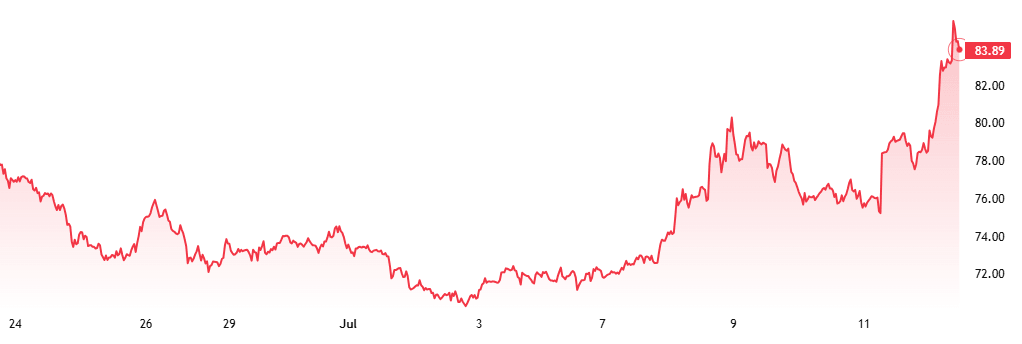
Brent crude futures (LCOc1) settled $7.29 higher, or 9.59%, at $83.30 a barrel. US West Texas Intermediate crude (CLc1) gained $6.73, or 9.42%, to $78.14.
Both benchmarks reached one-month highs. Brent recorded its largest daily dollar gain since 2 April, while WTI posted its strongest increase since 29 April, as traders restored a geopolitical risk premium that had faded during June’s temporary easing in hostilities.
Blockade Raises Tensions
US President Donald Trump said Washington would reinstate restrictions on Iranian maritime traffic after renewed missile and drone exchanges between US and Iranian forces. The US Navy-led Joint Maritime Information Center said the blockade was due to begin at 2000 GMT on Tuesday, 14 July, and would cover Iran’s coastline, ports and oil terminals.
Trump also said the United States expected reimbursement amounting to 20% of cargo shipped through the strait for providing security. The International Maritime Organization opposed mandatory transit charges, saying international straits should remain open to navigation and that such fees lacked a legal basis.
Iran said it would not accept US control over the waterway. Tehran announced that passage was suspended until stability returned, although US officials maintained that commercial vessels were still moving through the area.
Shipping Flows Slow
The Strait of Hormuz connects Gulf producers with markets in Asia, Europe and elsewhere. Before the latest conflict, it handled roughly one-fifth of daily global oil and liquefied natural gas supplies, including exports from Saudi Arabia, Iraq, Kuwait, the United Arab Emirates and Qatar.
Confirmed vessel crossings fell by about 52% over the weekend compared with the previous week, according to shipping data cited by Investing.com. Reduced traffic can quickly raise tanker charter rates, insurance costs and delivery times even when physical exports have not stopped completely.
“Restrictions on Iranian maritime traffic and sharply reduced vessel flows have intensified concerns over near-term supply availability,” analysts at Gelber & Associates said in Monday commentary.
Inflation Risks Return
The latest surge reversed part of the decline that followed a US-Iran memorandum of understanding on 18 June. That agreement was intended to reopen the strait, halt hostilities and support a recovery in oil production and trade.
Only days before the renewed escalation, the US Energy Information Administration had lowered its third-quarter Brent forecast to an average of $74 a barrel. It expected rising production and improving traffic through Hormuz to rebuild global inventories. Monday’s price move showed how quickly those assumptions could change if shipping is again constrained.
Higher oil prices could also complicate the inflation outlook. More expensive crude can feed into transport, manufacturing and consumer prices, potentially limiting the scope for major central banks to lower interest rates.
Danni Hewson, head of financial analysis at AJ Bell, said a safe-passage charge combined with higher insurance costs “could bring new global price pressures”.
Broader Supply Implications
Gulf producers have some pipelines that bypass Hormuz, but existing alternatives cannot replace all seaborne exports. A sustained disruption would leave Asian refiners particularly exposed and could encourage buyers to seek more crude from the United States, West Africa and other regions.
Goldman Sachs estimated that planned pipeline expansions could eventually protect more than 60% of pre-war Gulf oil exports from future Hormuz disruptions by the end of 2028. Until then, the strait will remain a major vulnerability for global energy markets.
Outlook
Traders will monitor whether the US blockade begins as scheduled, how many tankers continue to enter and leave the Gulf, and whether further military exchanges damage energy or shipping infrastructure.
Markets will also watch diplomatic efforts to restore the June agreement. Any verified return to normal traffic could remove part of Monday’s risk premium, while prolonged restrictions or attacks on commercial vessels could push oil prices, freight costs and inflation expectations higher.