

Oil prices extended gains on Monday as fresh attacks by the United States and Iran on vessels in and around the Strait of Hormuz heightened fears that disruption to Middle Eastern crude supplies could persist. Brent crude rose 0.54% to $96.80 a barrel, while US West Texas Intermediate gained 0.72% to $92.14.
Market Snapshot
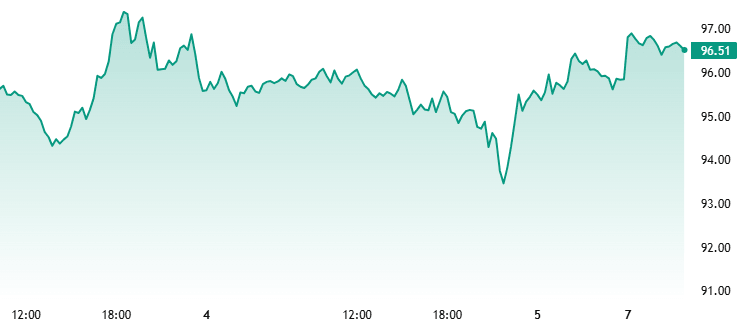
Brent crude futures had gained 7.8% last week, while WTI rose nearly 10%, after renewed US-Iran fighting reduced oil flows through the Strait of Hormuz.
The latest advance kept crude prices close to five-week highs. The market has increasingly priced a prolonged disruption to shipments through the waterway, which previously carried about one-fifth of global oil supplies.
The escalation has also widened the gap between physical supply availability and normal shipping patterns, increasing the risk premium embedded in crude prices.
Tanker Attacks Raise Supply Risks
US forces struck three Iranian oil tankers on Saturday, according to US Central Command. One of the vessels was hit off the coast of Kharg Island, Iran’s main oil export hub.
Iran’s Islamic Revolutionary Guard Corps Navy said it had targeted three oil tankers travelling through unauthorised routes in the Strait of Hormuz, as well as three additional US vessels elsewhere.
The attacks mark a significant escalation because commercial shipping has increasingly become directly exposed to the conflict. Maritime intelligence firm Marisks described the latest developments as a major escalation in the maritime conflict.
It said commercial tankers were now being used as instruments of economic pressure, reducing the distinction between military operations and commercial shipping.
Hormuz Traffic Falls Sharply
The Strait of Hormuz remains the main concern for oil traders. Kpler data showed that an average of only 10 commodity vessels passed through the strait each day over the past 10 days, the lowest level since May.
The waterway connects the Persian Gulf with the Gulf of Oman and the Arabian Sea. Major oil exporters including Saudi Arabia, Iraq, Kuwait, the United Arab Emirates and Qatar depend on routes through the region.
A sustained reduction in tanker traffic could therefore restrict exports even if production capacity remains available. That distinction is important for prices because additional crude cannot easily compensate for barrels that cannot reach international buyers.
Iranian officials have also said a restricted zone will be announced outside the Strait of Hormuz in the coming days. Any further restrictions could increase shipping costs and keep energy prices elevated.
OPEC Plus Holds Output Policy
OPEC+ left its oil output policy unchanged for October at a meeting on Sunday, giving producers more time to agree new quotas before determining their next production steps.
The decision comes as the conflict complicates the group’s ability to manage global supply. Additional production would have limited immediate impact if crude cannot be transported safely through the Gulf.
The market is therefore paying closer attention to actual export flows rather than production targets. Alternative routes can provide some relief, but they cannot fully replace the capacity of the Strait of Hormuz.
Prolonged Conflict Could Extend Disruption
ANZ analysts said a prolonged standoff involving calibrated military action by Washington and Tehran appeared the most likely scenario.
They expect Middle Eastern oil exports to remain constrained through the rest of 2026, with a gradual reopening of disrupted routes potentially beginning late in the fourth quarter. A return to pre-conflict throughput is not expected until late in the first quarter or early in the second quarter of 2027.
That outlook suggests the market could remain sensitive to individual military incidents, tanker movements and diplomatic developments for months.
For oil consumers, prolonged disruption would increase the risk of higher fuel and transport costs. For central banks, sustained energy inflation could complicate interest-rate decisions by keeping broader price pressures elevated.
Outlook
Traders will watch the next developments around the Strait of Hormuz, particularly whether commercial tanker traffic falls further or begins to recover.
They will also monitor any additional US or Iranian strikes against vessels and energy infrastructure. Further attacks could push crude prices higher by increasing the perceived duration of the supply disruption.
OPEC+ production decisions and diplomatic efforts to restore safe navigation will provide the other major signals. A meaningful recovery in shipments could ease the risk premium, while continued restrictions could keep Brent near or above the $100-a-barrel threshold.